In the first issue of Homegirl NYC, Khalya Hopkins shares her story of being 15 and pregnant. She was dealing with a lot at the time—a boyfriend in jail for committing a gang-related crime, threats against her safety, finding out she had chlamydia, and dealing with neighborhood gossip. She says, “that summer was rough. I was the talk of the neighborhood, called every negative thing you can think of. My friends’ parents did want them to hang out with me because they thought I was a bad influence. It hurt.” But she made it through the hard times and now, at 24, she’s a successful teacher. What happened to her happened ten years ago, but have things changed all that much?
Question. How do pregnant girls get treated at your school? What do people say about them behind their backs? That they’re fast? Irresponsible? Statistics? Ruining their lives? What do you say? Or, what have you had said about you?
Gabby Rodriguez talks Stereotypes, Rumors and Statistics. Photo courtesy of Seattle Weekly.
Well, one teen wanted to find out for herself, so she posed as a pregnant teen. Gaby Rodriguez, 17, walked around with a fake belly for six months for her senior project “Stereotypes, Rumors and Statistics.” A straight-A student, Gaby wasn’t spared any of the usual gossip so she wrote down what people said about her and talked about how it made her feel during an assembly where she revealed her ruse. Gaby hoped that what she learned would help other girls (especially other Latinas who statistically have a high rate of teen pregnancy) fight stereotypes. Seems extreme, but do you think she made her point?
I have a confession to make. This evening, I did something that I said I would never do- I went to see “Good Hair,” the newish Chris Rock moviedocumentary comumentary (comedy masking itself as a documentary).
After I saw this trailer, I surmised that this film was not what it initially advertised itself to be (an informative, thoughtful and thought-provoking look into his why long, straight hair is considered “good” by many, particularly in the black community, which would help answer his daughter’s (and countless others’) question as to why her hair was not “good.” Instead, I got the distinct impression that the film would be more mocumentary (meaning, in this instance, a film mocking weave-wearing black women). So I decided that my $12.50 would be much better spent elsewhere. Then I heard a clip from a radio interview where Chris Rock was discussing the backlash the movie has received and he said that most people who were criticizing it, hadn’t even seen it. Fair enough, so I went to see it for the same reason I finally went to see a Tyler Perry film in the theaters- so that I can speak intelligently and factually about it. And here’s what I have to say.
Chris is a commedian…he might awant to stay in that lane. If I had paid to see this movie, I’d want my money back, but since I knew better, and I can’t retrieve the time spent watching it, I’ll take away an important lesson- trust your instincts. More specifically, I really disliked the wild and inaccurate generalizations made (by Chris) in the film, such as: you can’t (and better not) touch a black woman’s hair, black women are high maintenance because of the price of maintaining a weave, the cost of maintaining one may create some animosity between black women (who wear the weave) and black men (who help pay for it), black women’s hair (and its untouchability) may contribute to the breakdown in black relationships because it prevents black men from really getting close to black women and- my fav- may be a reason why black men are attracted to white women…because they can touch their hair and therefore, get closer to them….gtfoh with that.
Throughout the movie Chris seemed to imply that a) all black women wear weaves, b) reinforce every stereotype imaginable about black women and hair (i.e. they will pay to get their hair done with money they don’t have, they don’t swim or get it wet) without providing any counterbalance, c) that all black women have one texture of hair- nappy- and that if a black woman has long, straight hair, it’s a weave, d) natural hair doesn’t cost money to maintain; and he seemed to forget that d) that some women with natural hair also wear weaves, or hair extensions. Where was the nuance? Where were celebs like India Aire, Chilli from TLC, Erykah Badu, Jill Scott or Solange (although I think her hair cut was more recent) in this film? They weren’t.
And how do you have a movie about “good hair,” featuring only one celeb with natural hair and maybe a couple (literally 2) of other women with natural hair in the whole thing? I’ll tell you how…you can’t. That’s why the title, and the movie, is so fraudulent. The film was not about “good hair,” it was about weaves and the Bronner Bros. hair show. That’s what Chris really wanted to make a movie about all along and he should have kept it honest and stuck to that.
That said, I did learn a few things from watching the movie- 1) the circumstances under which Al Sharpton permed his hair (James Brown advised him to do so for cosmetic reasons before a visit to the Reagan White House to try to gain support for making Dr. Martin Luther King Jr.’s birthday a holiday) 2) Maya Angelou got her first perm at 70 ?!? Seriously. 3) Where a l ot of the human hair comes from- India- and the process by which weaves are made. That was extremely interesting. The rest, not so much. Sure, I had a couple of laughs (far fewer than most of my fellow movie-goers) but I was far from impressed. Don’t get me wrong, I’m no natural hair fanatic. Yes, I do have natural hair and yes I have had a perm and a press. But, I also agree with what Andre 3000 said, “Now question, is every nigga with dreads for thecause? Is every nigga with golds for the fall? Naw So don’t get caught in appearance.” And we shouldn’t.
However, Chris’ belief that telling his daughter that what’s in her head is more important that what’s on it is faulty because at the heart of her question was why she is not good enough, why her hair is not good enough, as is. (Btw, I wonder what his wife had to say to her daughter or about her own weave.) And this movie, sadly, will no more help her figure that out than the film will make any real difference. But maybe it wasn’t supposed to. Maybe getting the conversation started was his contribution.
There’s an organization in the city that I’m SO inspired by called Black Girls Rock! It’s basically and hands-on mentoring program for young girls of color and women in the arts intended to counteract so much of the negativity that’s already out there by encouraging girls to see themselves as they are- not as they are portrayed in mainstream media…hmm…sound familiar? Yeah. I thought it might.
Anyway, each year, they hold an awards show to celebrate the achievements of some of our favorite celebs who also give back. This year, the Fourth Annual Awards show was hosted by actresses Regina King and Tracee Ellis Ross. Some of the honorees included: Mary J. Blige, Raven Symone, poet Sonia Sanchez, Naomi Campbell, Janelle Monae, DJ Spinderella (of Salt-N-Pepa), Dr. Mehret Mandefro.
Here’s a video from The YBF.com from that event-
Throughout the year, they also host programs designed with you (and your talent/self-esteem/inherent greatness) in mind! From The Black Girls Rock! Scratch DJ Academy Program to the ‘I Rhyme Like a Girl’ Poetry Workshop, from the ‘Taste the World’ Program to Summer Camp and College Tours- there are a lot of varied options. If you’re interested, check out the program details here.
It’s Hispanic Heritage Week, y’all!!! (I thought it was a month-long celebration from Sept. 15-Oct. 15?) I have been slacking, I know, but I’m ready to catch up.
So, what better place to start than a story (and video) from NY1 on our newest United States Supreme Court Justice (and Bronx Homegirl) Sonia Sotomayor? Today, the first Monday in October, is her first day on the Supreme Court, as the court begins its new term.
Quick facts, just in case you haven’t been paying attention. Sonia Sotomayor was born in the Bronx in 1954 to two Puerto Rican immigrants. Her father, who did not speak English or have much formal, worked in a factory and her mother was a telephone operator and later a nurse. Sotomayor was diagnosed with diabetes at age 8 and her father died when she was 9. She was raised in the Bronxdale Housing Projects where her family lived.
Sonia Sotomayor went to Princeton for college and graduated with the highest honors. She then went to Yale Law School. She married her high school sweetheart right before going to law school, but the marriage didn’t last. In law school, like in high school, she was an excellent student.
After law school, she worked as an assistant district attorney in NYC for five years, which began her distinguished legal career as both a prosecutor and a judge. In May of this year, President Obama nominated Sotomayor to the highest court in the country. She was confirmed, making her the first Hispanic judge on the Supreme Court, and the third woman, ever. Yes, you can. Or I should say, Si, se puede.
Read more about her, her experience, and views on controversial issues here. And about her “wise Latina woman” statement (and effect on the culture) here.
Hey, homegirls! What did you do this Sunday? I went to the Bronx Native- American Festival (that ride to Pehlham Bay Park was SO long from Brooklyn, but you know I’ll do anything for you, dolls!)
The festival was very much a family-oriented event- something you can go out to with the whole fam and have a fairly good time. And I was particularly impressed that the activities related back to Native American History specific to the area that is now the Bronx. The majority of the people there were families (with younger children), but there some teenage folk in the place, too.
I went, I saw, I heard, I learned, I recorded and I enjoyed, for the most part. I wish I had a video camera (working on that, next year definitely). But here are some pics from the day.
Activities with very well-informed park staff
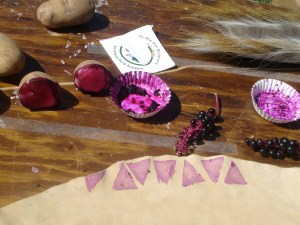
Supplies- potatoes, berries, and plastic forks
Instructions- use the knife to cut the potato in half; then carve a design in the potato and cut away the excess (creating a design pattern); mash berries in a small container; dip potato into mashed berries and apply to fabric or pottery!
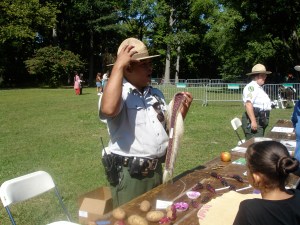
A little crowd participation
And voila! Decorated deerskin (SO soft) clothing, in this case.
Traditional (male) Headdress
MC
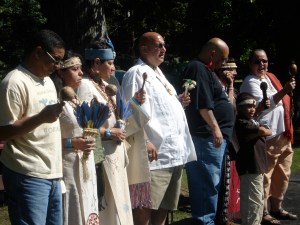
Live music/performances
A little fun for everyone (hopefully, including the horse)
Know me, love me, pet me
People came out
…and got to know each other (preparing to learn and do a traditional dance)


 Quick facts, just in case you haven’t been paying attention. Sonia Sotomayor was born in the Bronx in 1954 to two Puerto Rican immigrants. Her father, who did not speak English or have much formal, worked in a factory and her mother was a telephone operator and later a nurse. Sotomayor was diagnosed with diabetes at age 8 and her father died when she was 9. She was raised in the Bronxdale Housing Projects where her family lived.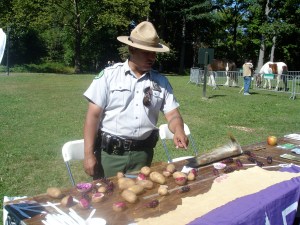














 Homegirl NYC