Archive

My Story

Hey all,

I know it’s been a while, but I’m back (I know, again). Truth is, starting this magazine (and trying to make it pop) has been a lot of hard work, even harder than I anticipated. Truth moment? I thought that having a good  great idea was enough. That all I had to do was to get the magazine finished (which took long enough), printed, and the world would recognize its awesomeness and praise/award me appropriately. Yeah. Welp, the world got me good. And for a minute there I got caught up in comparing my struggle to other people’s “successes” and I got bummed out. I doubted myself and I wondered if it was even worth it. I’m here, so what changed? Well, a few things. First, I met an amazing group of young women (Girls for Gender Equity, how y’all doin) and got excited about the mission of this magazine again. Like, I really got excited again. Then, I took a moment to honestly re-evaluate what I had done and why it didn’t work. And when I say I took a moment, I mean I read and researched and thought critically about what I was trying to do versus what I was actually doing. I switched up my game plan and recommitted myself to doing this work. So, I’m here. And I’m back to basics. That means, I’ve stopped focusing on all the awards I think I deserve and  all the great things to come and I’m working on reaching these girls, right now.

“Please help us find a home. We’re really good magazines. Honest.”

That said, I have a lot of copies of the first issue left. I’m not really concerned with making a profit selling them, as that ship has sailed. But I would like to get the issues out to some young women who might enjoy them. So, I’d you know of any groups, schools, programs, homes, centers, etc. where I can send a packet of magazines, please let me know.

Also, stay tuned. Because I’m going to be blogging about the process of getting this issue of the magazine out and, well, I plan to do so honestly, so you might not want to miss it.

~Until next time

Khalya Hopkins

One of the most talked about articles in the first issue (and a fav with the GGE crew) was about Khalya Hopkins. If you haven’t read her story, you should, but in brief, she got pregnant when she was 14 (under some difficult circumstances) and didn’t let being a teenage mom stop her from finishing high school, going to graduate school and becoming a teacher. It wasn’t glamorous or easy, but she did it. Meeting her, talking to her and hearing her story, it’s not hard to understand why. She’s driven.

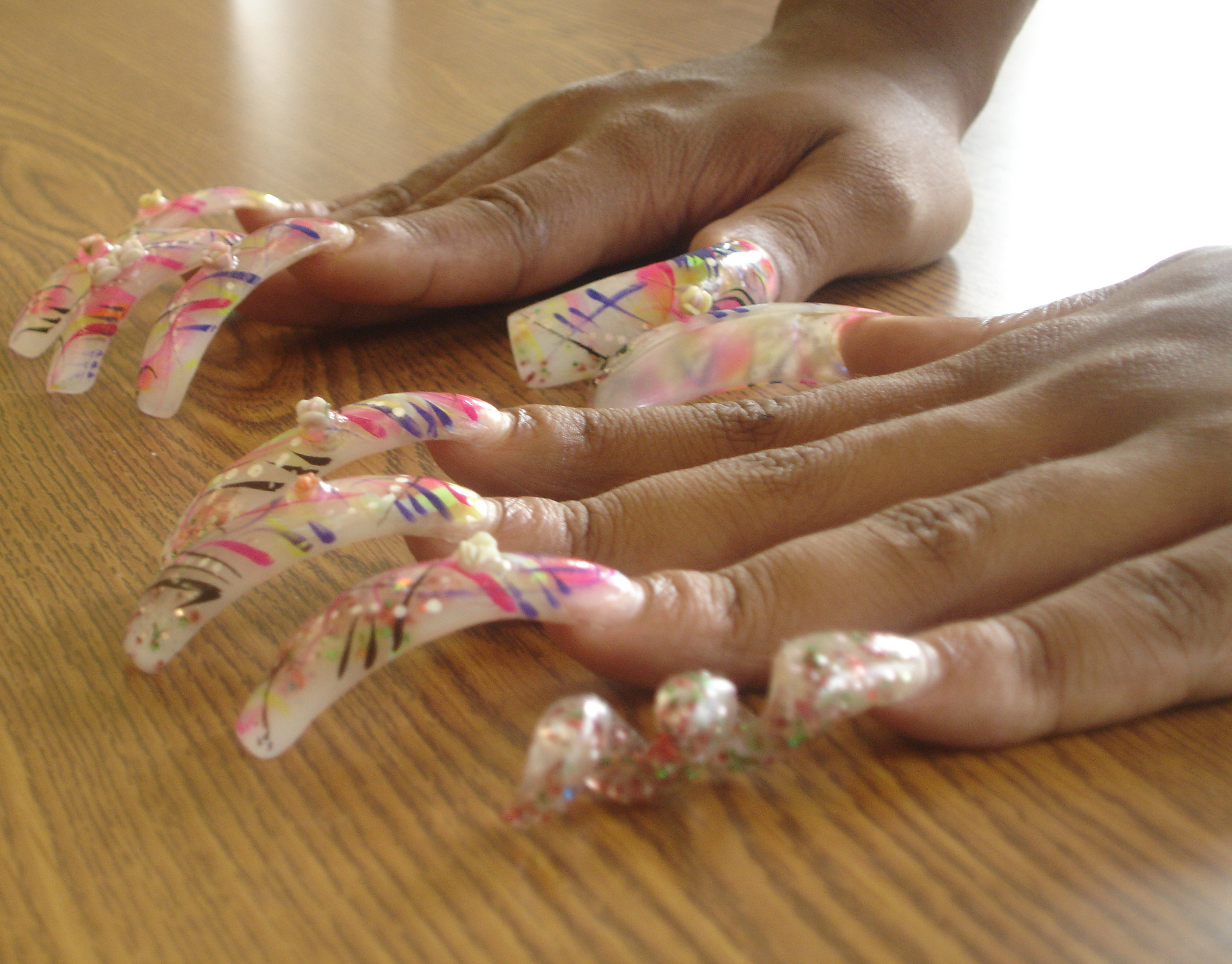
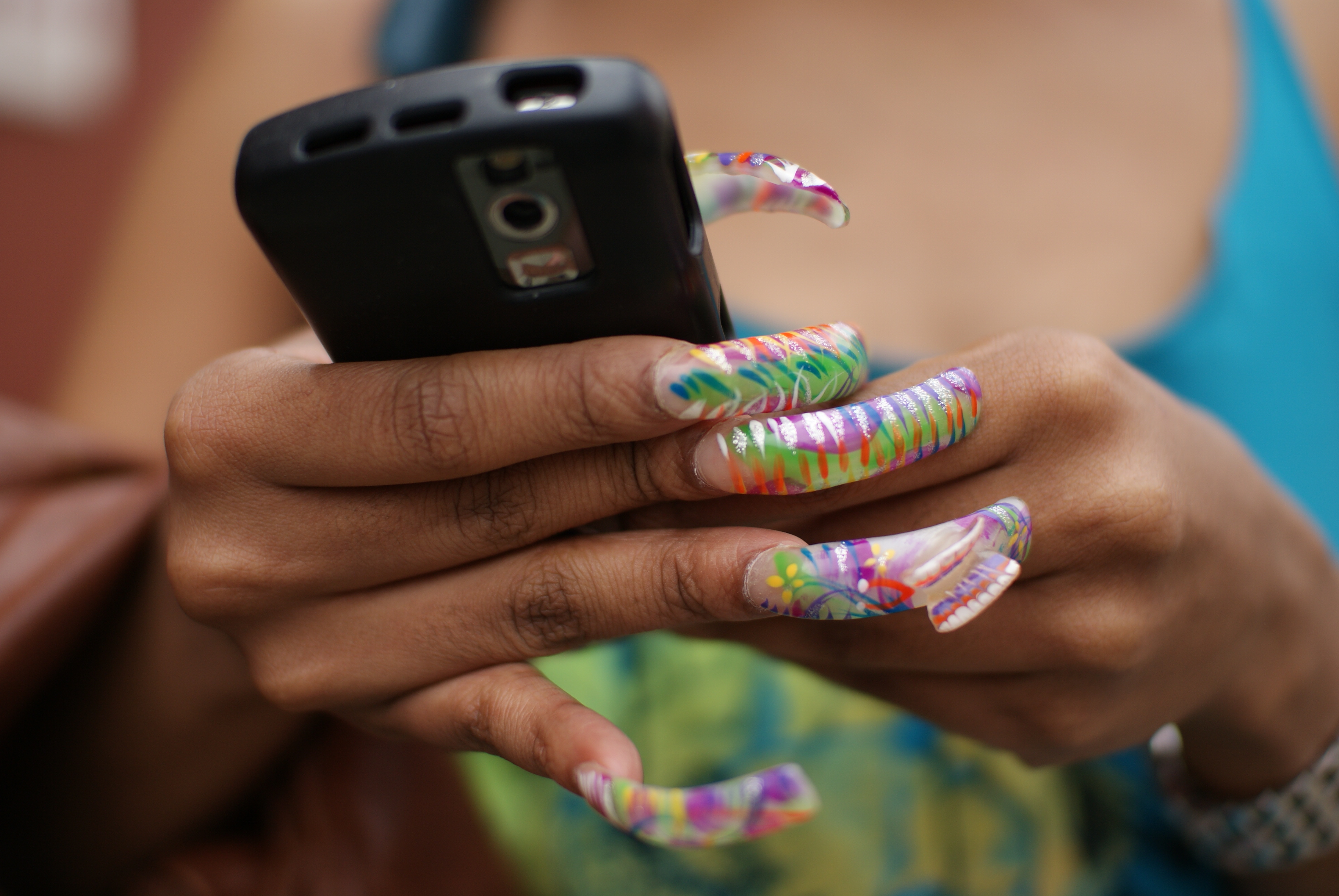
The first thing I noticed when I met Khalya, though, were her nails…and I had to ask her about them during our interview.  “In high school, the first year, you’re fresh meat,” she said. “Every guy is trying to bag you. The honors girls are the ‘it girls,’ if you’re cute, it was extra. We were in high demand.” After she had her daughter, though, things changed. “I was a real bum,” she said. “We went from 10 to zero on the radar, looking raggedy. It was a joke, our children were fly.”

"My parents told me, don't half ass anything," Khalya said. "That's my policy on everything."

Things started to pick up , she got a little money and she’d get her hair done. She started getting her nails done at 14 because she wanted to be creative. “In high school, your whole purpose in life is to out-do your friends, whether you say it or not. I wanted to be known for something other than my daughter.” So she let it be known that any guy she dated had to get her nails done. She started getting long tips in college and soon she became known for it, so she got as creative as she could. The reactions have been mixed- “That’s not professional,” and  “How can you work?” are common comments. There are people who want to take pictures and others who are repulsed. But Khalya says, “They’re not professional and I don’t ever pretend that they are, however, they are icebreakers,” and they get the conversation started. What she has to say is certainly worth it.

"You always want to have your own identity...if it's on your own terms, it's cool." Photograph by Valerie Caesar.

Some of the GGE girls really related to Khalya’s story (the boyfriend drama) and were happy to see her succeed. They also wanted to know how it ended—

Did her father’s boyfriend even get out of jail? Yes.

Are they back together? No.

What happened? Her parents tried to get her to reconcile with him because they wanted a traditional family unit and wanted to use it was a way to “de-gay” her, but the relationship did not work. She’s also gay, btw.

Can we contact her on facebook? Yes. Search for her name- Khalya Hopkins.

Today is HIV Vaccine Awareness Day. What does that mean, exactly? Well, scientists are still trying to find a vaccine to stop the spread of HIV. And they want to make people aware of what they’ve done, what they’re doing, and that they are still optimistic that they will find a vaccine. You may or may not be interested in the details, but take away the important (and simple) lesson- if you chose to have sex, protect yourself. Ok, it may not always be easy to do, but your life is worth it.

In the first issue of Homegirl NYC, international AIDS activist Hydeia Broadent, who was born with HIV and had full-blown AIDS by age three, shares her story. Here’s an excerpt:

Hydeia Broadbent on the cover of Poz magazine. Photo courtesy of the magazine.

“I am 26 years old. I take 3 HIV/AIDS medications a day and I go to the doctor every three to six months, more if I am feeling ill. I went to college but I had to stop going because I was sick and needed to rest. It is possible for someone living with HIV/AIDS to have a relationship but partners have to be educated on how to stay safe. I am dating someone I have known since high school. We plan on getting married after he is done with school. At one point I was madly in love with someone who was ashamed of letting people know I had full-blown AIDS, which hurt and sometimes brought me down. From that I learned I needed to date a man who was sure of who he was and able to handle people if they said negative things. I can have children without passing HIV onto them but I’m not sure if I will take that risk. I try to stay positive because there are people who are no longer here with us, and I don’t want to walk around depressed when I have a heartbeat. So I try not to think about death. I look at it like everything that lives and breathes will die—I could get hit by a car. I try not to think about it ‘til that day comes. Yes, it’s always there in the back of my mind but it does not affect my everyday outlook.

Hydeia B. in 2009, by Robert John Kley. Photo courtesy of Hydeia.

I am an HIV/AIDS activist. I travel all over the country and the world, speaking at colleges, health conferences and youth events about HIV/AIDS. People think they can tell when someone has HIV/AIDS–they have an image in their minds of maybe of a gay man or an IV drug user, as if those are the only people at risk. I am here to say that image is so wrong! Take me as an example and wipe that right out of your mind. Please remember your health is your responsibility, no one else’s! If you are in a relationship, go with your partner to get tested. If you can’t go together, is this really the person you should be sleeping with? It’s 2010 and we need to understand you can die from having sex! Yes, sex is a beautiful thing and I am not telling anyone not to have sex, but I am tell you to be safe and educate yourself. Getting tested is free and so are condoms in different heath centers or free clinics in every city. All you have to do is Google locations or look them up in the phonebook. We all need to do our part, this is our problem!”

Today is HIV vaccine awareness day… spread the word. To find a testing site near you, visit www.hivtest.org.

Connect with Hydeia online through email (Hydeiabroadbent@gmail.com) or on myspace at http://www.myspace.com/hydeiabroadbent. Check out the rest of what Hydeia had to say in the magazine, available now

In the first issue of Homegirl NYC, Khalya Hopkins shares her story of being 15 and pregnant. She was dealing with a lot at the time—a boyfriend in jail for committing a gang-related crime, threats against her safety, finding out she had chlamydia, and dealing with neighborhood gossip. She says, “that summer was rough. I was the talk of the neighborhood, called every negative thing you can think of. My friends’ parents did want them to hang out with me because they thought I was a bad influence. It hurt.” But she made it through the hard times and now, at 24, she’s a successful teacher. What happened to her happened ten years ago, but have things changed all that much?

Question. How do pregnant girls get treated at your school? What do people say about them behind their backs? That they’re fast? Irresponsible? Statistics? Ruining their lives? What do you say? Or, what have you had said about you?

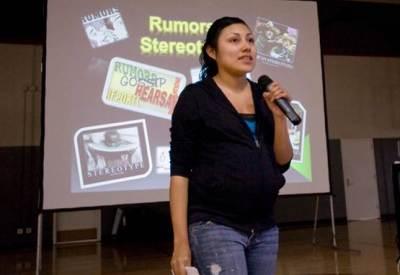
Gabby Rodriguez talks Stereotypes, Rumors and Statistics. Photo courtesy of Seattle Weekly.

Well, one teen wanted to find out for herself, so she posed as a pregnant teen. Gaby Rodriguez, 17, walked around with a fake belly for six months for her senior project “Stereotypes, Rumors and Statistics.” A straight-A student, Gaby wasn’t spared any of the usual gossip so she wrote down what people said about her and talked about how it made her feel during an assembly where she revealed her ruse. Gaby hoped that what she learned would help other girls (especially other Latinas who statistically have a high rate of teen pregnancy) fight stereotypes. Seems extreme, but do you think she made her point?

By now we all know that life isn’t fair. And that it doesn’t spread it’s unfairness around evenly—some people get too much, while others never seem to get enough. So what do you do when it seems like life keeps picking on you? Whatever it takes to change your circumstances.


Timeica E. Bethel talks about the long journey from the projects to Yale. Image courtesy of msnbc.com.

Meet Timeica Bethel, a college senior who grew up rough. Her drug-adicted mother abandoned her when she was three and sent Timeica (and her three siblings) to live with their grandmother in the LeClair Courts public housing projects in Chicago. Timeica loved to read, excelled in school, got a scholarship to private high school and went to Yale University, where she’s now a senior. She graduates in May and plans to go back home and teach the kids who are now live where she’s from that anything’s possible. Check out her interview with msnbc and see what she has to say for herself.

And I’m not trying to get all “where there’s a will there’s a way” preachy on you, but don’t let people kill your dreams.

-arcynta

On Friday night, Rihanna spoke to Diane Sawyer on 20/20 about dating violence and her relationship with Chris Brown. This was her first time speaking out about “the incident” (let’s call is what it is- the night Chris Brown battered her) publicly. It wouldn’t be a stretch to call it a “publicity stunt” for her new album (because, let’s face it, the timing is certainly no coincidence) but the fact that she is speaking out about it publicly remains a powerful thing. I stand by that. So, if you missed it, catch the full interview here-

and here,

and here,

Ladies, dating violence is very real and it is very serious. It can happen (and it does happen) to anybody. Speaking out about what it is, who and how it affects us helps take away the stigma. If you are being abused or know a woman (or man) who is, understand that the shame is not yours, nor is the blame. Get help, and sometimes it helps to speak on it.

Khalya Hopkins is the kind of girl people talk about. She had a baby when she was 15 and regularly sports two-inch, multi-colored nails, so, she’s used to the chatter. This time, Khalya’s having her say and opening up to hg-nyc about growing up in the Bronx, her teen pregnancy, and the struggle to define herself as more than just another statistic.

Khalya is from what she calls a “good family”—her biological parents have been together for 30 years; her mother stays-at-home and her father is an ironworker. Together they raised six children in the Bronx; Khalya was the second eldest and a daddy’s girl.

Khalya was 13 when she started dating the guy who would become her child’s father, a neighborhood kid she lost her virginity to after two months of dating. Most people who knew her were surprised. She was going into her high school honors program and he was 16 years old and already on probation. “Your options are kind of limited,” Khalya said. “You hit your puberty stages and guys start looking cute to you, but if you’re only in a ten-black radius majority of your day, this is who you come across.”

The two dated for ten months until things went downhill and they stopped speaking at the end of June. Then, within a four-day time span, Khalya’s life changed forever. In early July, he committed a crime, was arrested and sent to Riker’s Island—just in time for his seventeenth birthday. The next day, Khalya found out she was pregnant.

She had just finished her freshman year of high school. Her dad stopped speaking to her for two months. And because her ex-boyfriend’s crime was gang-related, she had to be isolated for her safety and the safety of her child.

And the bombs kept dropping. When she went to the doctor for the first time, she was tested for STDs and found out she had contracted Chlamydia, a disease that doctors told her could have blinded her daughter if not treated early.

“I was breaking down crying, because, you know, it’s bad enough that you’re pregnant, but now you’re diseased and pregnant so it gets worse,” she said. “That was a bad week for me.”

Khalya was overwhelmed, devastated and isolated, but she decided to have the baby.

While Khalya didn’t suffer from morning sickness, the strain of her pregnancy—doctor’s appointments, frequent trips to the bathroom, and fatigue—caused her grades to drop significantly. “Even though I didn’t drop out, I was definitely struggling just from a lack of time,” she said. “I had to deal with the pressure of possibly being kicked out of my honors classes and being put in ‘regular classes.’”

It was a lot for her to deal with, especially as a high school sophomore. “It wasn’t your average 15-year-old experience,” she said, “but it was my routine.”

Khalya had her daughter on March 6, 2000—she had just turned 15 in November. She was in labor for 3 ½ hours and gave birth naturally, with no epidural. She returned to school two months later, just in time to take her Regents exams, which she barely passed.

She took the summer to figure things out. She says that her family helped a lot—her little sisters and her mother would baby sit and her father gave her money. But being a teenage mom was hard.

“The first eight months, I was a terrible mother,” she said. “It was summer, my body had just gotten back to normal and I was like, ‘no I can’t be held prisoner in this house with this little girl, I don’t even know her,’” Khalya said. “I was just trying to escape, basically, and I think everybody could tell that.”

That summer, she was the talk of the neighborhood. Even her friends’ parents didn’t want them to associate with her, thinking she was a bad influence. Khalya says the negativity hurt, but it also motivated her.

Through it all, school was always a priority. “My dad said, ‘you’re not going to be pregnant and dumb, so you have to go back to school. Because if you’re stupid, this baby is going to be probably just a dumb as you are,” Khalya said. So she did go back to school, and was able to take her daughter with her.

The LYFE Program at her school helped a lot. Teen moms were allowed to keep their children in daycare, but they had to attend class; if not, Khalya said, they could lose their child’s spot in the program.

Through the program, the teen moms at her school were able to talk to teen moms at a Brooklyn school via satellite. “I thought that was probably the smartest idea they had,” Khalya said. “We would talk about issues that we had with our children and how we couldn’t study sometimes and how it was balancing our time and the relationships with our children’s fathers,” she said. It also gave Khalya confidence in talking about her own situation and made her interested in working with other teens.

Khalya graduated from DeWitt Clinton High School with a high school diploma and a Regents diploma a semester early. She chose to attend Hunter College through the Search for Education, Elevation and Knowledge (SEEK) Program; one that she says is for economically and educationally disadvantaged students. She had her own counselor and was able to enroll her daughter in day care at the school, while she was in classes during the day, for a reduced rate because of her income. She decided to major in English Adolescent Education and minor in Africana/Latino Studies.

Khalya says she graduated magna cum laude from Hunter with a 3.8 GPA. She was also inducted into the Phi Beta Kappa college honor society. That same year, her daughter, then 6, graduated from kindergarten. As a graduation gift, Khalya took the two of them on their first airplane ride— to go to Disney World.
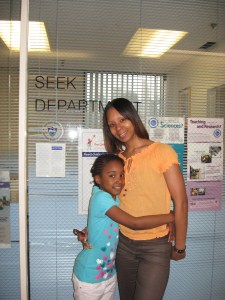
Khalya and her daughter

After college, Khalya want to graduate school and was hired as a recruitment counselor for the SEEK program. “It was almost like I was a spokesperson for more than one thing,” she said. “Not only was teen pregnancy an issue but my socio-economic status was a big deal because people believe that the only way to get rich or the only way to be successful is to wear chains and have certain types of jobs.”

Now, in addition to being a student and a mother, she was also a professional woman. Khalya also continued to work with teens, speaking at shelters, high schools and the Sojourner Truth house. She wanted to tell her own story and encourage them to go to school, or at least know that college is an option.

Khalya graduated this past spring with her master’s degree in English Literature. She also decided to work with teens full-time. “I felt like I was needed before they got to [the college] level,” she said. “There are not enough students looking at college as an option. So now I feel like I need to be with adolescents.”

Khalya has a way with people. She is very open and honest about her life and people, especially teens, open up to her because of it. And then there are her nails.

DSC02824

Khalya started getting her nails done in high school, to stand out for something other than being a teen mom.

“In high school, the first year, you’re fresh meat,” Khalya said. “Every guy is trying to bag you. The honors girls are the ‘it girls,’ [and] if you’re cute, it was extra.” But after she had her baby, she said she went from 10 to zero on the radar and regularly went to school looking “raggedy,” even though her daughter was fly. So, when she got a little money, she started getting her hair and nails done.

“In high school, your whole purpose in life is to out-do your friends, whether you say it or not,” she said. “I wanted to be known for something other than my daughter.”

She started getting long tips in college and just got as creative as she could with the designs. And they definitely attract attention, both positive and negative. One frequent comment is that her nails aren’t professional. “They’re not professional and I don’t ever pretend they are,” she said. “However, they are icebreakers.”

What started off as a teenage mom’s statement to the world, that “you’re going to see me,” is now her trademark. And so far, hasn’t hurt her professionally. After graduating from Hunter, she applied for the New York City Teaching Fellows Program and was accepted. She began teaching this fall.

When Khalya was 14 and pregnant, she wrote a letter, to her godmother, which she read back to Khalya after she graduated with her master’s degree. In it, a young Khalya said, ““I told you one day I was going to make you proud. This [pregnancy] is not the only thing you’re going to remember me for.”

Listening to herself at 14, Khalya said, “I don’t want people to remember me as a teenage mom, like that’s the only thing I’m good for.” So she uses her story and her voice to help make a difference.

Khalya says that her daughter is her biggest inspiration, outside of God. Her story may inspire other teens and teen moms  to say the same thing about her.
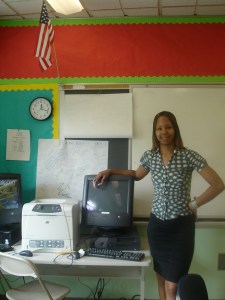
Khalya in her classroom