Khalya Hopkins is the kind of girl people talk about. She had a baby when she was 15 and regularly sports two-inch, multi-colored nails, so, she’s used to the chatter. This time, Khalya’s having her say and opening up to hg-nyc about growing up in the Bronx, her teen pregnancy, and the struggle to define herself as more than just another statistic.
Khalya is from what she calls a “good family”—her biological parents have been together for 30 years; her mother stays-at-home and her father is an ironworker. Together they raised six children in the Bronx; Khalya was the second eldest and a daddy’s girl.
Khalya was 13 when she started dating the guy who would become her child’s father, a neighborhood kid she lost her virginity to after two months of dating. Most people who knew her were surprised. She was going into her high school honors program and he was 16 years old and already on probation. “Your options are kind of limited,” Khalya said. “You hit your puberty stages and guys start looking cute to you, but if you’re only in a ten-black radius majority of your day, this is who you come across.”
The two dated for ten months until things went downhill and they stopped speaking at the end of June. Then, within a four-day time span, Khalya’s life changed forever. In early July, he committed a crime, was arrested and sent to Riker’s Island—just in time for his seventeenth birthday. The next day, Khalya found out she was pregnant.
She had just finished her freshman year of high school. Her dad stopped speaking to her for two months. And because her ex-boyfriend’s crime was gang-related, she had to be isolated for her safety and the safety of her child.
And the bombs kept dropping. When she went to the doctor for the first time, she was tested for STDs and found out she had contracted Chlamydia, a disease that doctors told her could have blinded her daughter if not treated early.
“I was breaking down crying, because, you know, it’s bad enough that you’re pregnant, but now you’re diseased and pregnant so it gets worse,” she said. “That was a bad week for me.”
Khalya was overwhelmed, devastated and isolated, but she decided to have the baby.
While Khalya didn’t suffer from morning sickness, the strain of her pregnancy—doctor’s appointments, frequent trips to the bathroom, and fatigue—caused her grades to drop significantly. “Even though I didn’t drop out, I was definitely struggling just from a lack of time,” she said. “I had to deal with the pressure of possibly being kicked out of my honors classes and being put in ‘regular classes.’”
It was a lot for her to deal with, especially as a high school sophomore. “It wasn’t your average 15-year-old experience,” she said, “but it was my routine.”
Khalya had her daughter on March 6, 2000—she had just turned 15 in November. She was in labor for 3 ½ hours and gave birth naturally, with no epidural. She returned to school two months later, just in time to take her Regents exams, which she barely passed.
She took the summer to figure things out. She says that her family helped a lot—her little sisters and her mother would baby sit and her father gave her money. But being a teenage mom was hard.
“The first eight months, I was a terrible mother,” she said. “It was summer, my body had just gotten back to normal and I was like, ‘no I can’t be held prisoner in this house with this little girl, I don’t even know her,’” Khalya said. “I was just trying to escape, basically, and I think everybody could tell that.”
That summer, she was the talk of the neighborhood. Even her friends’ parents didn’t want them to associate with her, thinking she was a bad influence. Khalya says the negativity hurt, but it also motivated her.
Through it all, school was always a priority. “My dad said, ‘you’re not going to be pregnant and dumb, so you have to go back to school. Because if you’re stupid, this baby is going to be probably just a dumb as you are,” Khalya said. So she did go back to school, and was able to take her daughter with her.
The LYFE Program at her school helped a lot. Teen moms were allowed to keep their children in daycare, but they had to attend class; if not, Khalya said, they could lose their child’s spot in the program.
Through the program, the teen moms at her school were able to talk to teen moms at a Brooklyn school via satellite. “I thought that was probably the smartest idea they had,” Khalya said. “We would talk about issues that we had with our children and how we couldn’t study sometimes and how it was balancing our time and the relationships with our children’s fathers,” she said. It also gave Khalya confidence in talking about her own situation and made her interested in working with other teens.
Khalya graduated from DeWitt Clinton High School with a high school diploma and a Regents diploma a semester early. She chose to attend Hunter College through the Search for Education, Elevation and Knowledge (SEEK) Program; one that she says is for economically and educationally disadvantaged students. She had her own counselor and was able to enroll her daughter in day care at the school, while she was in classes during the day, for a reduced rate because of her income. She decided to major in English Adolescent Education and minor in Africana/Latino Studies.
Khalya says she graduated magna cum laude from Hunter with a 3.8 GPA. She was also inducted into the Phi Beta Kappa college honor society. That same year, her daughter, then 6, graduated from kindergarten. As a graduation gift, Khalya took the two of them on their first airplane ride— to go to Disney World.
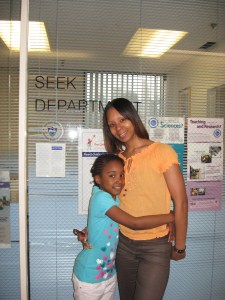
- Khalya and her daughter
After college, Khalya want to graduate school and was hired as a recruitment counselor for the SEEK program. “It was almost like I was a spokesperson for more than one thing,” she said. “Not only was teen pregnancy an issue but my socio-economic status was a big deal because people believe that the only way to get rich or the only way to be successful is to wear chains and have certain types of jobs.”
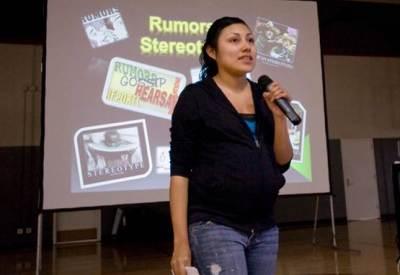
Now, in addition to being a student and a mother, she was also a professional woman. Khalya also continued to work with teens, speaking at shelters, high schools and the Sojourner Truth house. She wanted to tell her own story and encourage them to go to school, or at least know that college is an option.
Khalya graduated this past spring with her master’s degree in English Literature. She also decided to work with teens full-time. “I felt like I was needed before they got to [the college] level,” she said. “There are not enough students looking at college as an option. So now I feel like I need to be with adolescents.”
Khalya has a way with people. She is very open and honest about her life and people, especially teens, open up to her because of it. And then there are her nails.

Khalya started getting her nails done in high school, to stand out for something other than being a teen mom.
“In high school, the first year, you’re fresh meat,” Khalya said. “Every guy is trying to bag you. The honors girls are the ‘it girls,’ [and] if you’re cute, it was extra.” But after she had her baby, she said she went from 10 to zero on the radar and regularly went to school looking “raggedy,” even though her daughter was fly. So, when she got a little money, she started getting her hair and nails done.
“In high school, your whole purpose in life is to out-do your friends, whether you say it or not,” she said. “I wanted to be known for something other than my daughter.”
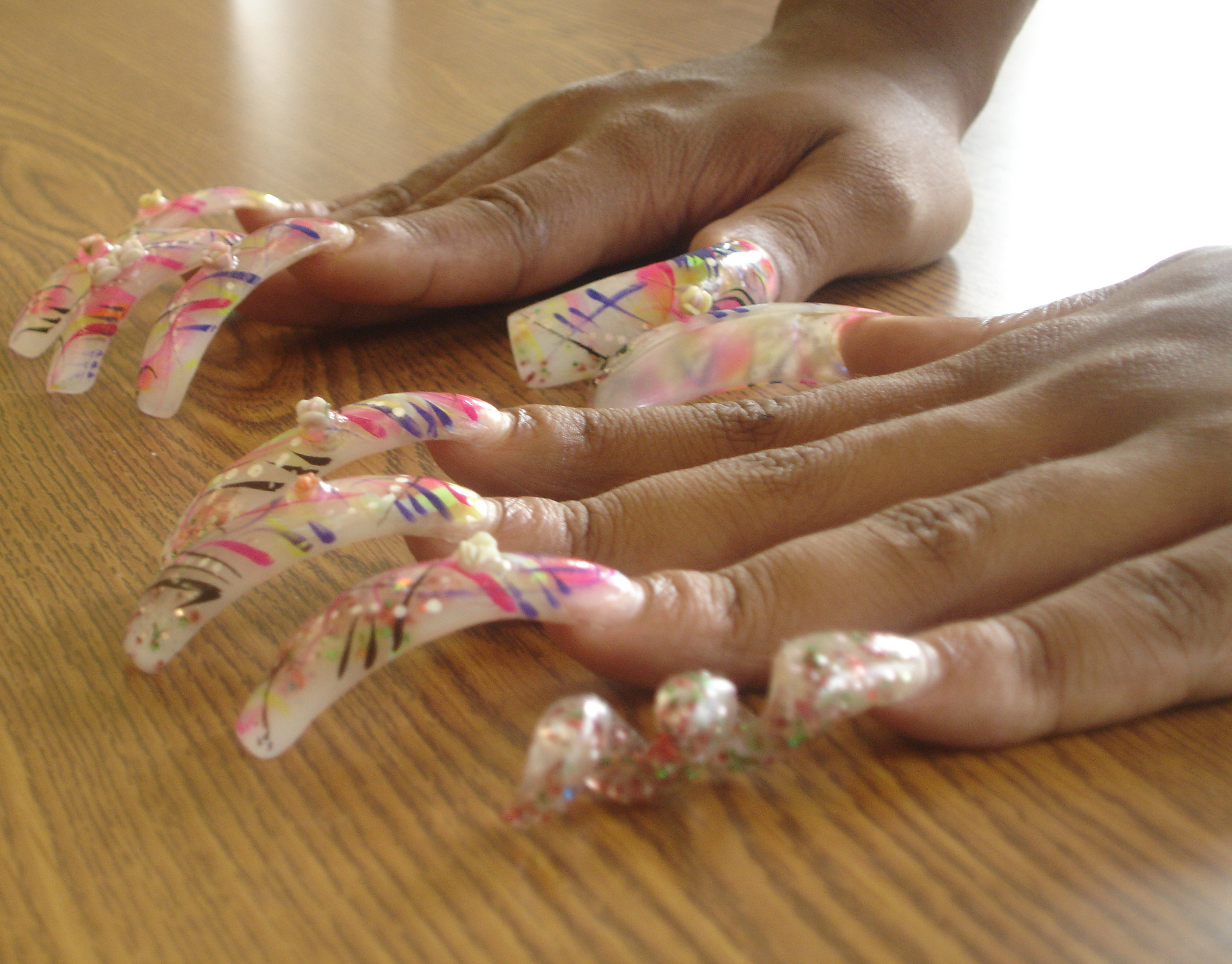
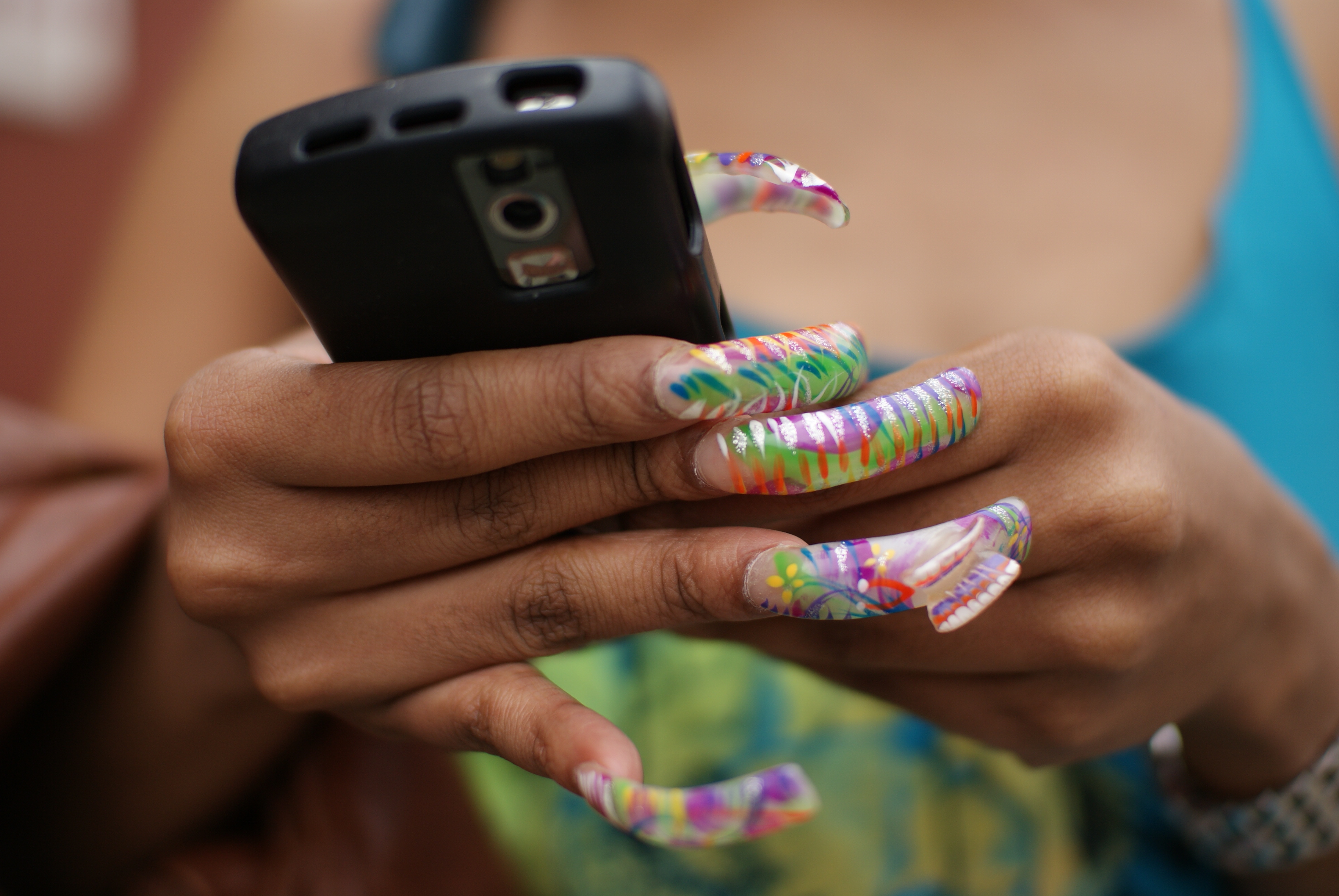
She started getting long tips in college and just got as creative as she could with the designs. And they definitely attract attention, both positive and negative. One frequent comment is that her nails aren’t professional. “They’re not professional and I don’t ever pretend they are,” she said. “However, they are icebreakers.”
What started off as a teenage mom’s statement to the world, that “you’re going to see me,” is now her trademark. And so far, hasn’t hurt her professionally. After graduating from Hunter, she applied for the New York City Teaching Fellows Program and was accepted. She began teaching this fall.
When Khalya was 14 and pregnant, she wrote a letter, to her godmother, which she read back to Khalya after she graduated with her master’s degree. In it, a young Khalya said, ““I told you one day I was going to make you proud. This [pregnancy] is not the only thing you’re going to remember me for.”
Listening to herself at 14, Khalya said, “I don’t want people to remember me as a teenage mom, like that’s the only thing I’m good for.” So she uses her story and her voice to help make a difference.
Khalya says that her daughter is her biggest inspiration, outside of God. Her story may inspire other teens and teen moms to say the same thing about her.
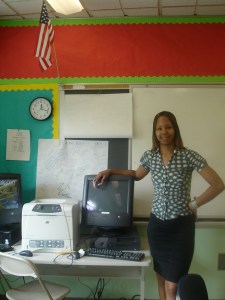
- Khalya in her classroom



 Homegirl NYC